Showing posts with label China. Show all posts

Wednesday, May 26, 2010

Chinglish Fruit Beverage

Seriously? There was no way I could pass up this photo op at lunch today.

Thursday, June 18, 2009

Chinglish Menu Fun

A couple of interesting menu choices I encountered on my recent trip to Dongguan City, China. As always, these are my own original photos.

Panda what? Um... I thought those were endangered or something. I guess "steamed" sounds better than "steaming" in this case.


You know, if I have to eat intestinal fat bone, it's always nicer with harsh flavors.

Thursday, May 07, 2009

Xiao Sichuan - Lunch Heats Up

One of the nice things about southern China is its diversity of food offerings. Many people living in this area have come from surrounding provinces looking for work, in the process creating a market for all varieties of Chinese cuisine. Just around the corner from where I’m staying is a small Sichuan place I’ve wanted to try for some time, Xiao Sichuan. We decided to take a break from drinking at the fire hose of Cantonese food, as we typically do when we come here, and give this place a try.

Unless you live in a cave somewhere, you probably know that Sichuan food is famous for its fiery bite (all apologies to the Geico cavemen). But you may be surprised to know that heat is only half of the equation. “Ma la” is the term that Chinese use to describe the unique blend of capsaicin induced heat in combination with the numbing action of the eponymous Sichuan peppercorn. Not actually related to our old friend black pepper, the Sichuan peppercorn is the flower/seed pod of a variety of prickly ash tree – hence it’s Chinese name, “hua jiao” (flower pepper). It’s assertive, citrusy flavor is just the beginning, as it contains the chemical hydroxy-alpha-sanshool, which causes localized numbness. This tingly sensation together with spicy heat is the hallmark of Sichuan cuisine.

I have to admit that I am not really sure what half of this stuff was, despite my best efforts to find out. So I’ll tell you what I know, but my descriptions are probably going to be pretty lame. One thing I do know quite well though – this food was delicious, and cheap too.

One of 3 Dongguan City Xiao Sichuan locations - the name may mean "little Sichuan," but the flavors sure were big.


Slow cooked pork belly over preserved vegetables

Rich, fatty pork was cooked slowly until meltingly soft was served over a bed of dried preserved leafy greens. This was a nice way to start things out and ease the chili-phoebes in gently, as it was one of the few dishes that wasn’t really spicy.

Spice rubbed lamb skewers

Loaded with flavor, the lamb was coated in a cumin based spice rub, with just enough hot pepper to give your lips a buzz. The meat was amazingly tender, too. It was really a phenomenal plate of food, probably my favorite of everything we had. I could have pounded down this whole plate.

Spicy pork shanks

My second favorite after the lamb, the tender meat was still on the bones, giving us the chance to play barbarian as we devoured these tasty morsels. The taste was really, well, porky - just like pork should taste. I piled up quite the boneyard, but still can’t really explain just what was so unique about this item. But I loved it.

Cold plate of beef tongue and tripe - spicy, of course

A pile of thinly sliced offal was dressed up with a chili oil sauce, Sichuan peppercorn, some nuts, and cilantro. This is a pretty traditional dish that I’ve even found back in the States. The tongue, despite what you may think (you know who you are), has a nice rich beefy taste, so get over it. The tripe… well, the texture can be off putting. Okay, it is like chewing a rubber band made of cartilage. If you can get past that, the taste is actually pretty mild.

Whole fish soup, Sichuan style

Our table was quite happy with this soup, which featured a whole “water fish,” cut into paper thin slices. Tangy and intense, the broth was infused with mounds of citrusy Sichuan peppercorns. The humongo pile of dried chilies on top looked menacing, but did not overpower the light flavor of the fish. As with many of these dishes, cilantro added its distinctive flavor to the mix.

Four season beans

A version of this dish can be ordered from many restaurants here, but this version is one of the best I’ve had. Despite the fierce looking dried chilies, this dish was actually not that spicy. There has got to be something special seasoning the beans. They tasted a little salty, but there was an overwhelming savory enhanced bean flavor that was totally addicting. Maybe a hit of MSG was used to boost the umami???

Kou Shui Ji

The Chinese name for this dish is literally “mouth water chicken.” So does that mean “salivating chicken?” “Chicken saliva?” Or maybe something more innocuous like “mouth watering chicken.” In China, you can never be too sure. Either way, this cold dish was moderately spicy, with those mouth numbing peppercorns once again. It had a distinctive flavor that was a common thread through many of the dishes, but I couldn’t begin to tell you exactly what it was.

Sichuan beef with peppers, real fire

So this beef was served stir fried with fresh hot peppers, but the heat didn’t stop there. No, no, in the bottom right corner of the plate you can see a dish of crushed red chilies for dipping to taste. Above that was flaming sterno to wave your meat through and add a touch of char before scarfing down. This was another delicious dish, but be careful! The manual chili application may lead the careless diner to OD.


Satisfied with a fantastic lunch, my mind began to wander into 6th grade territory. Yes, in a land already fraught with intestinal challenges for foreign visitors, what would a full meal of searing heat do to a person? Let’s not go there…

Perhaps the most impressive thing about this lunch was the value. Most plates shown were about $4, with just the fish reaching a lofty $9. Beats a happy meal any day of the week.

As spicy as some of the dishes were, I have to admit that I was expecting much worse. I even asked if they toned it down for us westerners, but we were assured that they did not. Although each item individually maxed out at a solid “medium” on the pepper scale, the cumulative effect left a lingering tingly sensation around my lips and tongue. According to one of my Chinese colleagues (a Sichuan native), the food would have been considerably more spicy in her hometown. Here’s to visiting someday - I look forward to the challenge. But in the mean time, whenever I come to Dongguan, I'll be stopping by Xiao Sichuan.

Monday, March 17, 2008

Chinglish Shop Sign in Dongguan

No surprise to see translation humor in China. This one was particularly funny.

A shop on the street in Dongguan City, China. Since those XXXL T-shirts I bought fit like muscle shirts, maybe I can find something here that will fit.

Saturday, March 15, 2008

Mao Jia Fan Dian (Mao's Family Restaurant)

Dinner with the Chairman

Once again, coming to you live from the People's Republic! I had visited a Hunan style restaurant a while back which was decent, but it was a very casual neighborhood kind of place. I had a chance to step it up a bit with a visit to Mao's Family Restaurant, a chain of restaurants established in 1987 by a distant relative of the late Chairman. This place serves up a proud tradition of dishes representing fiery cuisine of Mao's Hunan provincial heritage. A new Moa Jia branch has just opened up right down the street from my hotel in Dongguan City, so I decided to bring some of my colleagues and check it out. Typically, my trips to southern China involve numerous Cantonese mega-meals, so I thought it would be nice to change things up.

The Chariman himself is waiting to greet you upon entering. You'd better like the food, though, or else!


Chrysanthemum Tea - The tea server jets his arm back and raises the teapot up next to his head, shooting a laser of boiling water right into your cup. Nice aim, buddy.


Ma La Xia - Spicy Numbing Shrimp - Although food here is primarily Hunan sytle, this dish throws a nod to neighboring Sichuan province. Shrimp are skewered, fried, and topped with garlic, dried chilis, and a generous helping of mouth numbing Sichuan peppercorns. This dish is always a winner for me, and it was great this time as well.


Snake - Well, this was a new one for me. When we were reading the menu, I thought it would be fun to order this. But when the dish was brought out, I was a little taken aback to see how, well, how snake-like it looked. But Rich!! (you're thinking) It is snake! I know. But, seriously, look at the picture. I had no idea the skin would be so vividly blue. And look at that piece right in the front. That's where the freaking head goes! I should point out that there was also a mountain of stir fried hot peppers and garlic.


Yup. That's me, eating snake. The taste was surprisingly mild and non-exotic, almost like fish - but with a lot of bones, which made it difficult to eat. Yeah, lots of bones. The peppers had a nice kick, too.


Eggplant and Four Season Beans - Fantastic flavor on this one. When I asked how it was seasoned, they told me that there wasn't any special seasoning, it was just normally seasoned. Whatever that means, it was great. I could have eaten this whole dish myself.


Hong Shao Rou - Red Cooked Pork Belly - We couldn't come here without ordering this, the Chairman's favorite dish. Five spice seasoned chunks of pork belly are stewed in soy sauce and spices, and were served over a bed of dried mushrooms and unidentifiable vegetables. The belly pieces were incredibly soft, with tender meat surrounded by soft, gelatinous fat (belly is, of course, what we use in the States to make bacon out of). The skin was left on, and had become soft and sticky. Of course, fat equals flavor, so this dish was obviously delicious. It was quite rich, though, as you might imagine.


Here is an inauspicious page of the menu, featuring, ahem, bull penis. Since I had already eaten one tubular meat product (snake), I decided to pass on this one. Okay... Maybe I would have passed anyways...


At the end of the meal, I was happy to have found a new place to put on my "regular spots to hit up when traveling to Dongguan City and staying at the Dong Cheng International Hotel" list (what - don't you have one of those too?). The food was good, and although moderately expensive by Chinese standards, it's still quite reasonably priced. One of my Chinese colleagues was unhappy with the portion size for the price, but the high quality and great taste was more than enough to balance that out for me. So if you're in Dongguan, go check it out for yourself. Just make sure to bone up on your Mandarin first.

Sunday, November 25, 2007

Wagyu (The Restaurant): Hong Kong's Aussie Steakhouse

A little over a year ago, I was walking through Central in Hong Kong and I happened to pass by a construction site for a new restaurant. The sign said Coming Soon - Wagyu. Once an unknown term in the western world, the past few years have seen an explosion of wagyu beef offered at high end restaurants and shops. It has even trickled down to more humble venues, often in the form of a wagyu burger. The mission of Wagyu restaurant, as I would later read in one of those handy guide magazines the hotels give you, is to bring prime grade-9 Australian wagyu beef to the masses at a reasonable price. This was a mission I could fully support.

What exactly is wagyu, you ask? Well, literally, it means "Japanese cow." It should not surprise you, then, to learn that it refers to the family of cattle breeds native to Japan that are used to produce such famed products as Kobe beef, Mishima beef, Matsusaka beef, etc. - literally beef unlike anything most have ever seen. What makes wagyu cattle so special is the tendancy to develop high amounts of intramuscular fat, which is known as marbling. The fat is responsible for giving meat flavor as well as keeping it moist and juicy, so more fat = better meat. Interestingly, wagyu beef contains less artery clogging saturated fat than typical beef, and is rich with heart healthy omega-3 and omega-6 fatty acids. So eat up.

The quality of a piece of beef is largely determined by the amount of marbling. Japanese Kobe beef is graded on a 12 point marbling scale. USDA Prime, the top US grade available, typically rates only a 5 on the Japanese scale. The highest grades of Japanese beef are more like fat streaked with meat (skip halfway down this page for photos), and can contain as high as 90%fat content! Meat like this should barely kiss heat, otherwise the fat will render out, creating a very expensive puddle. Wagyu cattle are now raised in limited numbers outside of Japan, mostly in Australia and the US, although in the US, they are often crossbred with American Angus cattle.


Ever since that chance enounter, I have been scouring the internet for info about Wagyu, with very little to show for it. They don't have a website (how can a business without a website even exist?). In fact, I could only find one review, but the writer made the unconscionable decision to not order the steak, skipping it in favor of fish. Um... Did anyone point out that this is a steak restaurant? With unusually high quality (not to mention hard to find) beef? The only option left was first-hand recon. I would have to go in myself. Fortunately, I was with some beef hungry friends last month while in HK, so I had the chance to make good on this plan.

The restaurant is located on the ground floor of The Centrium at 60 Wyndham St., a 10 minute walk or so from the new Star Ferry pier. Making the uphill walk to get there is a great way to work up an appetite, not to mention to take preemptive action against all those calories. The restaurant is tastefully decorated in typical modern restaurant style, with the front open to the street, giving it a quasi al-fresco kind of feel.

The menu offerings reflect the restaurant's Australian heritage (not like that other place), but within that culinary space are a fairly extensive selection of choices. A wide variety of hot (wagyu steak pie) and cold (wagyu carpaccio) appetizers are available, as well as many non-beef alternatives. Beef is priced by the cut and portion size (8, 10, or 12 oz). Australian Wagyu is, obviously, the house specialty, but there were other types of beef (Black Angus, for one) available as well. I was somewhat surprised to see that there were only a few different cuts of steak available. New York strip, my personal favorite (and likewise that of many beef aficionados), was inexplicably not on the menu (I asked the server). It was also surprising that the server didn't offer any explaination of the menu or the restaurant's namesake beef. I guess I expected them to showcase this fine product a bit more, especially with steak prices topping $100US. I took a pass on the filet (perhaps the most overrated piece of cow flesh) and settled on the 10 oz sirloin (don't even think about going past medium rare with meat like this). To accompany the steak, I added an order of the garlic-chilli chips and a bowl of mushy pea mash.

After a reasonable wait, the food was brought to the table. A selection of house made mustards and condiments was brought out to the table to accompany the steak. Everything looked fantastic, but I immediately realized that I had gone overboard on the potatoes. Not sure if I missed it on the menu or not, but I didn't realize that the steak would be served with roasted potatoes (and arugula salad, too, which was a nice touch). The garlic chilli chips looked great, so I was glad I had ordered those, but I had expected the mushy pea mash to be a pile of smashed peas, not mashed potatoes flavored with peas. At any rate, the server perhaps could have thought about my selections a bit and checked with me that all these spuds were on purpose.

You can see how juicy this steak is from this photo. Also on the plate are some mustard, the roasted potatoes, tomatoes, arugula salad, and portabello mushroom (it's hiding under the steak).

But potatoes schmotatoes - this dinner was all about the beef. One bite and I knew that this was truly exceptional meat. Tender and juicy, the steak melted in my mouth. Each bite delivered a buttery richness full of incredible beefy flavor. As nice as the mustards were, I preferred to eat the steak straight up, so that I could enjoy it unadulterated (what can I say, I'm a beef purist). Underneath the steak was a grilled portobello mushroom. It tasted fine, but didn't really enhance the steak for me. The arugula salad was nice and peppery, dressed with a mild vinaigrette. The chips were every bit as delicious as their crispy, golden exterior promised, with a mild chilli zing to tickle the tongue. I did also think the mash was tasty, but I would probably try something different next time for variety's sake.

These garlic chilli chips were totally GBD

Mushy pea mash was tasty - just not what I thought it would be

All said and done, I really enjoyed the food I ate here. The steak was fantastic, and the chips were also memorable. The pricing is comparable to other high end steakhouses in Hong Kong, perhaps even a little less. I would have liked to see a few more cuts of steak offered, however, and I just feel the service could be a little more in tune with the customer's needs. I would eat here again though without hesitation.

Bottom line: If you want super juicy, fantastic tasting steak, this place is worth a try.


----
Was this writeup helpful to you? Want to share your Wagyu experience? Please leave a comment below.

Friday, November 23, 2007

A Taste of Hunan

I was in Asia once again last month, but I'm just now getting around to posting some photos. I spent the first few days in China, briefly hit Hong Kong, and finally ended up in Kyoto, Japan for some sightseeing.


While in China, I was fortunate to have dinner with a friend from Hunan province. We were able to find a random Hunan style restaurant in downtown Dongguan City. Many westerners have heard of Sichuan (sometimes spelled Szechwan) cuisine, which is often misrepresented in American Chinese restaurants, but nevertheless correctly known for it's fiery spiciness. Most, however, are less familiar with Hunan cuisine, who's spiciness is equal to, if not stronger than that of Sichuan. I had never had the opportunity to eat Hunan style cooking before, but I was in for an interesting experience.

I took a few photos to give you an idea of what we had.


Beef, fresh chilli peppers, and cilantro - a fresh, light, and tasty dish (and oh yeah, spicy to boot).


Pig tails with fresh chillis, garlic, nuts, and an unknown Chinese vegetable - This dish had great flavor. The chunks of pig tail, however, had fairly tough skin, a microscopic layer of meat, and then a core of bone, so they were not exactly going to fill anyone up.


Duck feet with intestines and vegetables, served in a sizzling iron wok - No one eats duck feet to get full. There's maybe one or two bites of skin that can be gnawed off of these things before you are just pretending. It wasn't clear from the menu that this dish was going to have innards, so the intestines were somewhat of a surprise. Amazingly, despite all this, this dish had outstanding flavor. I can't tell you what was in that sauce, but I can tell you that it would make just about anything taste awesome.


Whole shrimp, fried and covered with 3 types of hot peppers - This dish was pretty straightforward. Heat was provided by the heaping mound of fresh cherry peppers, dried chillis, and the mouth numbing Sichuan peppercorn (typically used in Sichuanese cooking, oddly enough). I think this dish would make great stadium food - it's tasty, convenient to eat, and easy to pop down one after another. Of course, the heat adds up pretty fast.


For more Hunan food fun, see my report on Mao's Family Restaurant (Mao Jia Fan Dian).

Monday, November 20, 2006

Pizza and Sake? A Review of Hong Kong's Aqua Tokyo / Roma

On the surface, Japan and Italy do not seem to share much in common when it comes to culinary tradition. But think about this:

1. Japan and Italy both have people
2. Both countries look long and skinny on a map
3. Both countries have capitals that start with either the letter 'T' or 'R'

Two sides of the same coin. Birds of a feather. Kissing cousins.

Thus, it was only a matter of time until some master of the obvious created a restaurant featuring both of these sister cuisines. That someone is the Aqua restaurant group of Hong Kong.

Located on the 29th floor of the One Peking building in Kowloon, Aqua Tokyo/Roma/Spirit has an enviable location offering perhaps the city's best nighttime skyline view. But don't spend so much time looking out that you miss the beauty of the swanky modern interior.

The menu is organized into two halves - The Italian side on the left (read in the typical Western fashion, front to back) and the Japanese on the right (read Japanese style - back to front). As I began to drool over the sushi section, I read that Aqua flies in fish daily from Tokyo's Tsukiji Fish Market, so I was expecting good things.

I started out with a nod to my Italian heritage with a buffalo mozzarella pizza with fresh cherry tomatoes and arugula. This pizza was more Italian rather than American in design. The crust was perfectly thin and crispy, and the three topping elements were perfectly balanced, with the arugula adding a nice peppery kick to play against the mild, creamy cheese. I thought that this pizza would be perfect paired with a light, crisp Junmai Daiginjo sake, so I ordered a bottle. Premium sakes like this one should always be served cold, but you already knew that. It was a surprisingly excellent way to start the meal.


Now that's a good looking pizza.


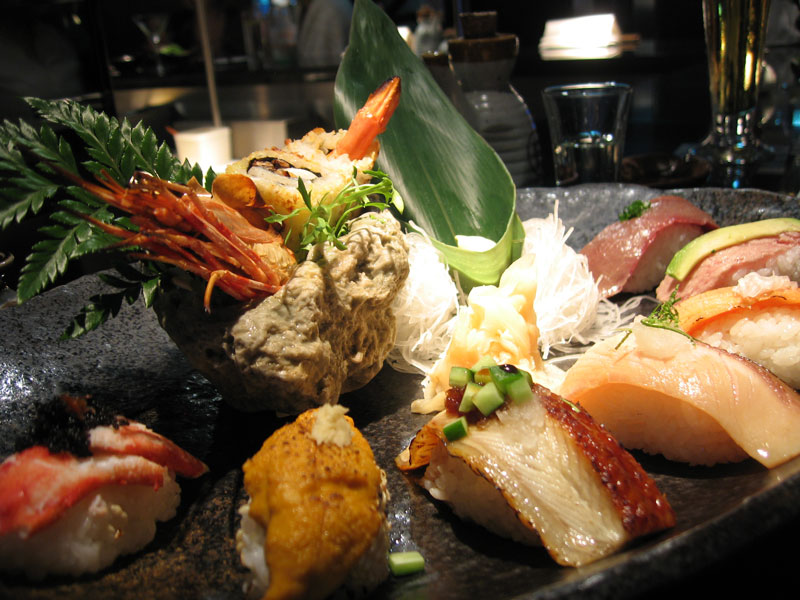
Next up was the Aqua Tokyo sushi platter - the restaurant's signature offering of nigiri sushi. As a contemporary twist, Aqua seared some of toppings and toasted some of the riceballs to accentuate certain flavors in the ingredients. Some pieces were also topped with iteresting items such as caviar or avocado. Standout favorites were the uni with toasted rice ball and the seared Japanese beef. All in all, I found each piece a well thought out and tasty combination of flavors.


A feast for the eyes as well. Starting from the left we have crab with caviar, uni (sea urchin), grilled eel, hamachi, salmon, tuna with avocado, and Japanese beef. In the center is a grilled prawn maki roll.


After the sushi, we were presented with salt grilled hamachi (yellowtail) collar. This is an item that wouldn't seem strange perhaps anywhere in the world except, of course, the good old USA. Don't be afraid, people! The meat around the collar bone was extremely delicate and flavorful, and the salt and soy based dipping sauce were the perfect accoutrements to bring out the richness of the fish.


This outstanding fish just melted in my mouth.


After this, a plate of king prawn tempura seemed a little pedestrian, but was nevertheless well executed and tasty. On the side was a dark green seasoning powder that was somewhat salty (konbu, maybe?) which was an interesting touch.


Beautifully crisp and not very oily - the mark of a good tempura.


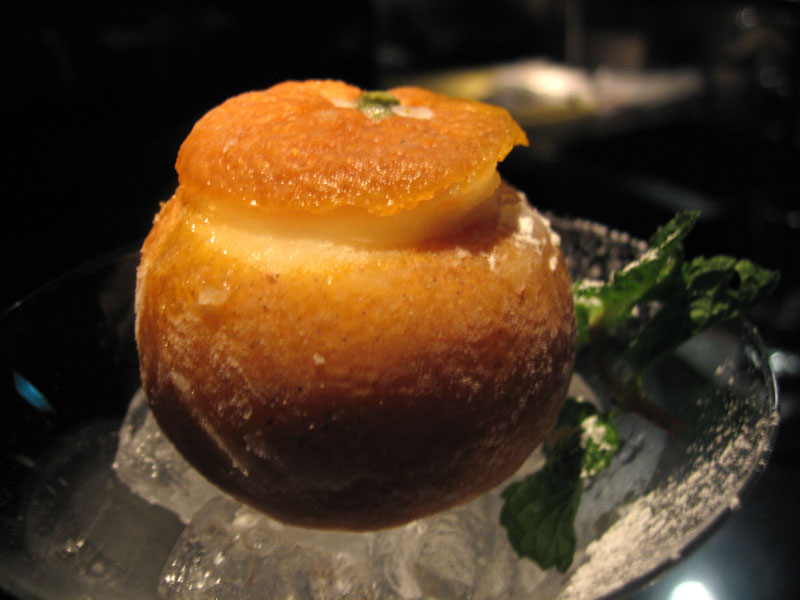
Finally, I couldn't pass up a Yuzu sorbet, served iside a frozen, hollowed out Yuzu fruit skin. Yuzu is a Japanese citrus fruit that can best be described as a mixture of lemon and lime, but a little more pungent. The sorbet was a nice way to finish up the meal.


Fresh yuzu is almost impossible to find in the States.


With a full belly, I left the restaurant as a very happy customer, hoping I would have a chance to return and sample more of the vast offering of menu items. Suddenly, the duo of Japanese and Italian didn't seem so strange.

In all seriousness, there are many things about these two cuisines that really are similar - chief among them is the dedication to using the absolute freshest ingredients possible and preparing them in such a way as to show off their natural flavors. Of course, each culture has applied it's own unique traditions to this principle, yielding wildly different results. But maybe... Just maybe they are not so different after all.

----
Was this writeup helpful to you? Want to share your Aqua experience? Please leave a comment below.

Wednesday, November 15, 2006

A Most Unusual Birthday

Is it just me, or has anyone else noticed that I seem to only have time to blog when I'm overseas?

Yeah.... That's what I thought. Given that, I'll give you one guess where my physical body currently lies.

Monday, November 13th, the anniversery of my entrance into the world, lasted a mere 17 and a half hours for me. You ask how that is possible? The answer is simple. At approximately 7:30pm EST, 39,000 feet above the North Pole, I crossed the international dateline, thereby skipping ahead into the future to November 14th. And who says time travel doesn't exist?

One of my favorite in-flight pastimes is to watch the map channel, where you can be endlessly entertained by watching the plane glide, one pixel at a time, onward towards your destination. All relevant flight stats (speed, altitude, distance, etc.) are, of course, displayed for your viewing pleasure. One of my least favorite in-flight pastimes is heading to the bathroom in my socks and having to maneuver around the puddles of urine left by unscrupulous co-passengers (What's so funny... everyone in Business takes their shoes off during the flight, okay?).

On this particular day, we were taking the polar route. As we neared the North Pole, some funny things started to happen to our plane on the tiny screen. As I watched the plane jerk about on it's axis, I couldn't help but think that I was glad that the on screen choreography did not match the actual flight experience.


Watch magnetic declination at work.


So it was that I was able to witness the approximate precise moment when my birthday ended. 4 and a half hours, sheared away in one brief moment. And thanks to this commemorative photo I snapped, you can follow along with me and share in my pain.

Watch this... Watch this here... Ready... Here it is... And... Bam! Boo yeah! That's what I'm talking about!


By the way, I should take this opportunity to welcome my Chinese friends to the 21st century. The ban on Wikipedia and my very own blog (okay, other blogs too) has been lifted and can now be viewed in the Middle Kingdom. Welcome to the planet.

Friday, September 15, 2006

Day 15: The Forbidden City - Forbidden No More

At long last, I had reached my final day in China (for this time, anyways). My flight was scheduled to leave from Beijing Capital International Airport at 4:30 in the afternoon, so I still had over half a day to spend sightseeing before I had to go. When it comes to Beijing, two major historical attractions come to mind - the Great Wall and the Forbidden City. Having conquered the Great Wall, there was one obvious choice for this day.

The Forbidden City, or Imperial Palace ('Gu Gong' for all of you wannabe Mandarin scholars), was the residence of China's emperors from 1420 until the fall of the dynasty system in the early 1900's. Located in the direct center of old Beijing, many emperors did not leave these grounds at all throughout their entire lives. Like everything else in Beijing, it's big - really big. Check out this satellite photo. For reference, you can see Tiananmen Square (remember, 82 football fields big) in the lower half of the picture.

I arrived at the Meridian Gate (that would be the pay entrance) at about 9:30, which gave me about 3 hours to see what I could before I had to get going. I bought my entrance ticket, picked up an audio guide, and headed inside. The map they handed me with my ticket was all in Chinese, except for the title "Imperial Palace Museum Guide Map" at the top. That's helpful. Fortunately, the audio guide comes with one in English, even if many of the buildings weren't labeled. Each area of interest was marked with an LED light on the map. The audio guide was activated by proximity, so as I approached an area, the audio started. After I had visited a place, the light went out, leaving only the places I had not yet been to still illuminated. Technology is great.

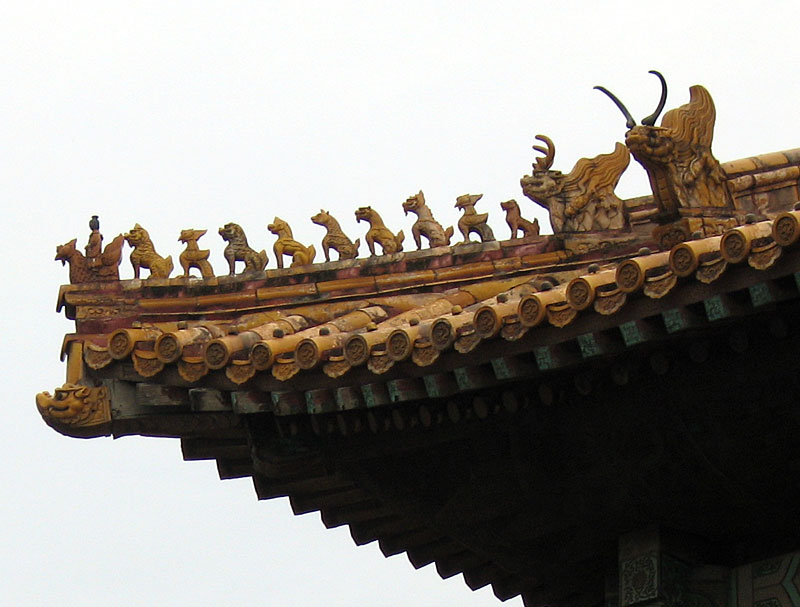
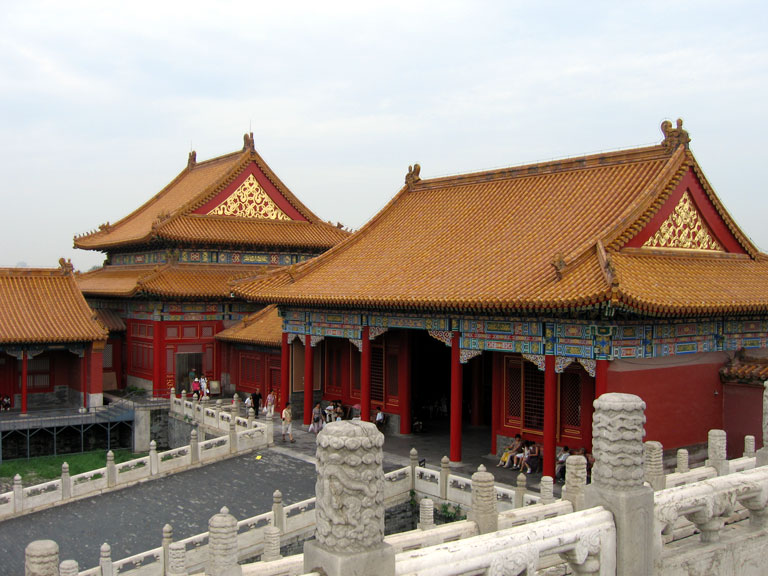
The architecture of the Palace is simply stunning. There are hundreds of ancient wooden structures, all topped with intricately tiled golden rooftops. Staircases are ornately carved out of enormous slabs of marble. Bronze dragons glid the doors and walls throughout the palace grounds. The corners of each building are marked with a series of little beasts parading behind the emperor. The more beasties, the more prominent the building. With 11 such creatures, the most important of the buildings is the Hall of Supreme Harmony. This is where the emperor's throne is located, and where he would typically host important visitors and conduct matters of state.

Beyond the Hall of Supreme Harmony is the Gate of Heavenly Purity. This is the entrance to the inner court, where the emperor and his family lived. I explored around the various halls and palaces for quite some time. Many of the hallways were narrow, sometimes leading to another palace or courtyard. Sometimes there was only one way in our out of these places. It was easy to get lost. Many of the smaller, side buildings contained exhibits of various historical artifacts or cultural exhibits.


The Hall of Supreme Harmony


The Emperor's throne, inside the Hall of Supreme Harmony


The little roof beasties


Somewhere in the courtyard outside some important Hall


Behind the inner court was an elaborate garden. One area had a rock garden with many ornately formed rocks. To the north end of the garden was a large rock with a pavillion perched on top. This was the highest point in the compound. Frequently, the emperors and their wives would climb up to the top and look out over Beijing.

In advance of the 2008 olympics coming Beijing, the city is in the midst a massive facelift. Many of the structures inside the Forbidden City are part of this enormous restoration project. While some buildings sported a bright, fresh coat of paint, others were faded and cracked, with peeling paint and rotted wood to reveal the true age and character of this place. In all honesty, I preferred the old to the new. It just gave me more a sense of the history that these walls have witnessed.


One of the many garden pavillions


Evidence of the true age of the City


I spent three hours there, and only managed to hit the highlights. It would be easy to spend an entire day there if you wanted to be thorough. But I had a date with an airplane that I was intent on keeping, so I caught the subway back to the hotel to pack and check out.

I was running low on time, so I decided to abandon the bus-to-airport plan and take a taxi. I asked the concierge how much this would cost and was told 120-150RMB. I only had 120 left, so I asked her to ask the taxi driver if this would be enough. After a brief exchange, she told me that it was no problem - this driver would take me. She also explained that there was a 10RMB road toll near the airport that would be included in the price. I got in the taxi and we took off.

Feeling a little uneasy, I decided to tell the cab driver how much I had just to make sure it would be okay - in Mandarin, of course (no he didn't speak English!).

"I only have 120RMB. Is that enough?"

"It's enough."

"Thank you."

"No problem. Wahd ajfkda sjkdh jdhg jatkah sjfhkj fjkaslfkds fjka;f asja waur iwon dkgas ajk fhasfjslgai ghajkdskjfl......."

Uh oh...

"Sorry, my Mandarin is not very good. I didn't understand."

3 more rounds of this and the driver was finally resigned to the fact that I did not, in fact, really speak Mandarin. We hit the toll booth and he motioned for me to give him money. I handed him 10RMB and soon we reached the airport. Out of curiosity, I had been monitoring the fare meter to see how much the tally would reach on the trip. As we pulled up to the sidewaly at the airport, the meter stopped on 114RMB. I got out and handed the driver the last 110RMB that I had, certain that we had established the limits of my funding capability. He looked at me funny and waved his hands saying (in Mandarin) "4 Renminbi! I need 4 more Renminbi!"

I said, "I don't have any more! No more!" We both kept saying the same thing back and forth to each other until the driver just waved me off and just drove away. I shook my head, thinking that I couldn't have been clearer about my cash situation. I should mention that 4RMB is about 50 cents.

With no money for food, I was thrilled to be a business class passenger with access to the lounge and it's free food and drink ameneties. As I sat and filled my belly, I reflected on my time in the capital city. Beijing was big. And old. And full of tourist traps and people trying to make a quick buck off of the "rich American traveller." Lots of culture, in some ways tied to propaganda of the past, and in some, marching towards modernization. All in all, it's been great to have had a front row seat to the rebirth of a nation.

It had been an exciting adventure with plenty of memorable moments. I was glad I had come, but was somewhat "gladder" that I was heading home. I used the wireless internet in the lounge to post a brief trip update, with the idea that I would play catch up once I had arrived home. A month and a half later, here is the final post of this trip. Sorry it took so long, but I hope that the stories made you feel like you were there, so that, in some vicarious way, you could take part in my experiences. I don't mind traveling alone, but the one thing I do miss is having someone to share the moment with me. So in that sense, thanks for reading along with me.

I will be home in the States until November, but rest assured I have a lot to write about here until my next China excursion. I also have tons more photos from this last trip, so I might put together another photo gallery at some point. And of course, I'll have another installment of language humor. Until next time...

Saturday, September 09, 2006

Day 14: The Great Wall

"If you haven't been to the Great Wall, you are not a real man."
- Mao Zedong


7:20am – The tour bus rumbled through the streets of Beijing. Despite being full to capacity with 40 passengers, there was a strange quietness in the cabin. I double checked my supplies for the day – 2 bottles of water, 2 Pocari Sweats, a package of dried mango, some spicy dried beef, and a sleeve of Ritz crackers.

At a total length of about 5000km, the Great Wall of China stretches the equivalent length of Boston to San Francisco. From Beijing, there are several places where you can go to see it. The easiest, closest, and most popular place is the Badaling section of the wall, but this was not where I was heading.

The Great Wall was built over a long period of time, with the oldest sections being over 500 years old. As you may imagine, maintaining a structure of such magnitude is somewhat problematic. As a result, about 85% of the wall is currently in poor condition. For this reason, the Badaling section of the wall was restored about 50 years ago by the Chinese government – reconstructed to resemble its past glory so visitors could marvel at its splendor. Thousands of people come to visit this section of the wall every day. They feast on Chinese delicacies like… McDonalds? KFC? They go… shopping at the mall? Wait a minute… This wasn’t what I had in mind - I was hoping for something more… Old. Authentic. Raw. I wanted to see the real wall.

So I started to research my options. Many people described hiking along the wall as a way to get away from the masses of tourists and see some incredible sections of the unrestored wall. The Simatai section was often cited as having the most spectacular terrain and scenery. Nearby was the Jinshanling section, which appeared to be an “unspoiled” stretch of the wall with few tourists. I found a couple of outfits online that combined both areas into one outing, and seemed reputable and affordable. China Adventure advertised 3 options for a one-day Great Wall hike:

1. Super Hiker – Get dropped off at the Jinshanling section and hike 10km to the Simatai section. Then, climb another 5km to the top of Simatai.
2. Regular Hiker – Same as #1, but skip straight to the parking lot at the end instead of scaling the Simatai portion.
3. Leisure Hiker – Skip straight to the Simatai section only, no hiking.


Map of Great Wall areas near Beijing, courtesy of China Adventure


I was a little worried about the Super Hiker option. I am not a Super Hiker. But, this was my only trip to the wall, so I wanted to make the most of it. No one had forced me to decide yet, so as we were driving the 130km from Beijing to the wall, I was weighing my options. Even with no hiking, you would still get to see the real wall and spectacular scenery. The weather was cloudy and spitty, not the best for beautiful mountain vistas, but it would do. After 3 hours in a bumpy bus with 40 strangers, we had arrived at Simatai. The guide stood up and barked out in broken English something like “Anyone for no hiking get off now!” This was the moment of decision. I looked around to see what everyone else was going to do. I noticed a couple of guys maybe a little younger and a little skinnier than me jump up and say, “No hiking! That’s what I’m about!” They quickly ran out of the bus. This did not help my confidence. But everyone else stayed put - even the old lady. I was sure I could outwalk her. Before I could make up my mind, the bus drove away. Decision made, for better or worse. At this point, I tentatively titled this post “Rue the Day.” Mentally, I shifted gears and began to psych myself up for the hike.

We arrived at the Jinshanling section and got out of the bus. Since I was alone, I surveyed the crowd for some people who might be good to buddy up with (read: no triathletes or grandmas). The bus was going to be waiting for us at the Simatai section in about 4 hours and I didn’t want to lose my group and get left behind. Most of the people who came this day were couples, but there were a few loners like myself. As we hit the trail up the mountain to the wall, everyone kind of took off at their own pace. I just went with the flow, trying to make sure I stayed somewhere in the middle of the pack, remembering the faces of the other group members. My legs were already burning as we made the steep climb up the mountain to the wall. I kept thinking I was going to regret staying on that bus.

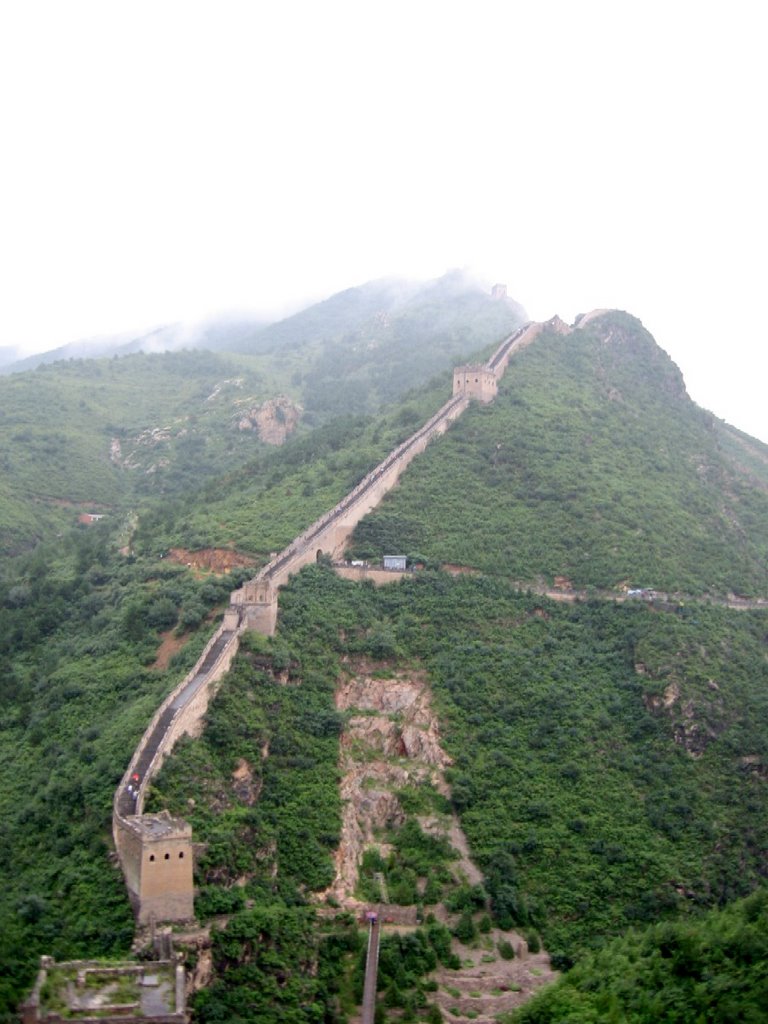
And then, all of a sudden, there it was. A few more steps, and I was standing on the Great Wall. I looked out and saw this continuous stretch of brick and stone, strung across the peaks and valleys of the mountains, snaking like the mythical dragon into the clouds. It was quite a sight.


Awesome view of the Great Wall.


Viva Pocari!


Like every other giddy tourist there, I began snapping photos at a dizzying pace. In every direction around me were bare mountains showing little evidence of human development. The thick clouds hung like a mist, giving an air of mystery and intrigue to the landscape. Buoyed by the spectacular view, I was reenergized and started walking.

Soon, the entrance disappeared behind me and the condition of the wall began to worsen somewhat (it seemed obvious that the entrance area must be fairly well maintained). The top surface of the wall was uneven with bricks broken and missing here and there. Wild vegetation was growing from the cracks between the bricks. The wall itself was not very wide – maybe about 10-15 feet at most, just enough for two people to walk comfortably side by side.

At first, the stretch of wall was fairly flat, sometimes slightly uphill, sometimes slightly downhill. However, as the nature of mountains tends to be, I soon came upon a steep climb. At this point, the wall became like a giant set of stairs. Navigating them was particularly tough because the steps were all different sizes. Some of the bricks were loose and unstable. And the steps were steep – some up to a 70 degree slope, making it tough to make it up without using your hands to steady yourself (more like climbing a ladder than stairs). At some points, the wall was in such poor condition that there were no sidewalls at all. I couldn’t help but think that there is no way they would allow access to a place like this in the States. Too many lawyers.

Watchtowers were located at regular intervals along the wall. Each one served as a marker of progress and offered a place to rest for a moment before continuing on. Up the stairs… Down the stairs… Up the stairs… Down the stairs…


A typical stretch of steps along the wall.


Some of the guard towers have been reduced to rubble.


There were lots of steep areas like this one.


After a couple of hours, I crossed into the Simatai section of the wall. It had begun to rain lightly, which was kind of refreshing given how hot I had been the day before. I was a little hungry so I stopped in a guard tower and pulled out my dried mango. I opened the package and grabbed a tantalizing piece of yellow… wait, brown mango flesh??? What was this garbage? I tasted it… Crap. It’s that nasty, sour, salted stuff. At least I have this jerkey… Hmmm, the dried pork(?) was hard and chewey with little redeeming flavor. Guess that’s what I get for not being able to read Chinese characters. Fortunately, anything tastes okay washed down with a little Pocari Sweat.

A while later, I reached a narrow footbridge suspended over a river. Walking across it was a little spooky – it was a small suspension bridge anchored to the sides of the mountains on either of the river. The floorboards were small wooden planks, and the bridge swayed back and forth with each step. On the other side of the bridge, was the path to the parking lot – I had made it! Of course, this brought on another decision – head to the bus, or continue to the top of Simatai.

The summit was shrouded in clouds, which meant that even if I was able to reach the top, I wouldn’t be able to see much. By now, the rain was steady and I was pretty wet. I still had an hour until the bus left, but my legs were not happy. Ahead of me was the longest, steepest stretch of steps that I had come across on the hike. These steps were serious. These steps were pain. Nevertheless, I had come this far, so I decided to give it a try


The impressive Simatai section of the Great Wall.


Slowly and deliberately, I trekked up the stairs. My legs burned with each and every step. I could only go a short while before having to stop and catch my breath. I hit the first guard tower, which was pretty high up. Just past the tower was a short stretch of stairs that leveled out on a ridge for a bit before shooting straight up to the top. I checked the time – 40 minutes till bus departure. Even if I were to make it to the top, I would still have to turn around and come back. I just didn’t have the time. I headed up to at least hit the ridge so I could see the view before I headed back down. There I stood, at the edge of the clouds, watching the wall dance across the mountains, disappearing in the mist. Standing there alone in the pouring rain, I raised my hands to the heavens and let the wind and rain kiss my face. What an experience.


The steep climb to the first Simatai guard tower.


The view from the highest point I hit. I had hiked across all of the wall visible in this photo. Hope the wind doesn't blow my camera over the side!


I climbed back down the stairs carefully – the rocky steps were steep and very slippery. On the way to the parking lot, I stopped at a small souvenir shop and picked up a cheesy “I climbed the Great Wall” T-shirt for $2. What a deal. The thunderstorm continued, but at this point, I was already completely soaked through, so it didn’t really matter. I found the bus, climbed on, and collapsed in my seat. I was so glad to be still. I had survived the day, and was anxious to get back to the hotel and crash. In 3 short hours, I would be there.

Well, almost.

The first sign of trouble was when we pulled out of the parking lot of Simatai and traffic on this small two lane road was at a dead stop. We waited about 10 minutes without moving when the driver decided to make a U-turn. With a tour bus. Did I say it was a two lane road? After another 10 minutes (spent coercing the cars behind us to move, and then executing the turn), we headed back towards the parking lot. This time we went out the back way. I had no idea if it would actually be faster or not, but since we were moving, it at least felt like progress. About 15 minutes later there was a very loud bang on the back right side of the bus, followed by a mass turning of heads and furrowing of brows. The driver pulled over to inspect the damage. “Flat tire,” he said as if it were no problem at all (I should point out that this bus had the dual tire configuration, so there was still one good tire left on that side). He climbed back in the driver’s seat and continued down the road. A couple of minutes later, we began to hear a thump-thump-thump-thump sound coming from said tire. It seemed to be increasing in frequency and loudness as the speed of the bus increased. We had no choice at this point, the tire would have to be fixed.

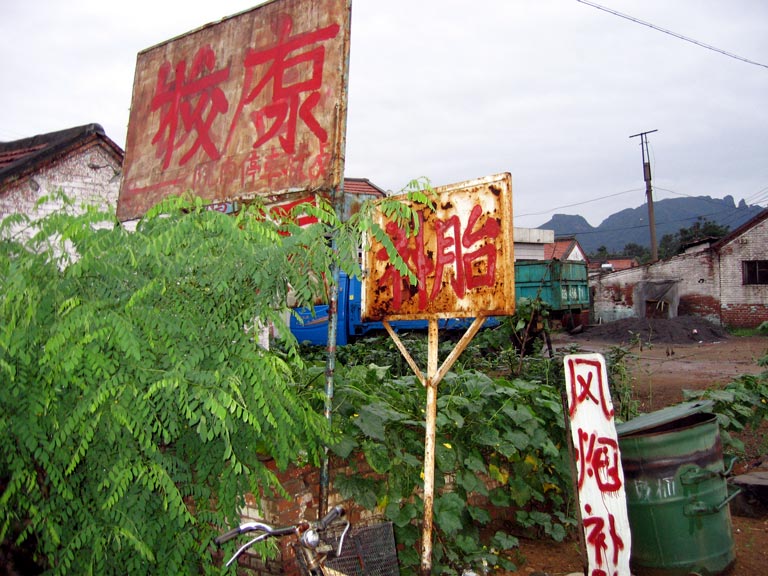
The problem was that we were in an area of small villages with modest brick houses, where corn fields, bicycles, and dirt paths were more common than more modern things, like for example, auto parts. We pulled over on the side of the road near this small building that had handwritten signs posted on the outside.

Apparently this sign says something like, "Tire Repair." I'm not making this stuff up.


The driver got out and put a piece of wood behind the rear wheel. He then backed the bus up onto the wood, suspending the bad tire in the air. At this point, the bus emptied as all of us passengers had to get out and take a look at the damage. The driver went to talk with one of the villagers, who then went into one of the small buildings and extended a compressed air hose out to the bus. Then, he connected a massive air-driven torque driver to unscrew the bolts from the wheel. What do you know, I guess they do have auto shops out there! As the mechanic worked to remove the wheel, shutters clicked and flash bulbs strobed as all of us curious passengers supervised the proceedings. Everyone got quite a chuckle out of the situation. Fortunately, the bus was equipped with a spare tire and within 15 short minutes, we were ready to roll again. I got back on the bus and realized that it was warm, humid, and stunk like a locker room. Only 3 more hours.


The busted tire and the "jack"


A village boy plays outside.


There was an interesting mix of people in the group. It seemed that of all the people there, I was the short timer – “You’ve only been in China for two weeks?” Well ‘scuse me people. I also was one of the precious few who were staying in an actual hotel. There were scores of crunchy earth, hostel-going euro types. I only ran into one or two other Americans. There were Aussies, Germans, Danish, Norwegians, Brits, Italians, Canadians and Belgians to name a few. Everyone was extremely friendly. On the wall, I had met a German software manager who was in his 9th month of a 2 year assignment living in Beijing and a Canadian couple living in Beijing teaching English. On the bus, I sat next to a Norwegian seismologist who had just spent two weeks in Tibet and was one of the very first to travel on the new high altitude train to Lahsa. There was a Belgian girl who had traveled from Europe via the Trans Siberian Railroad. There was a foreign-born Chinese girl who had made the long trip to Asia to learn about her heritage. A British woman had brought her 7 year old son who kept asking “Are we almost done?” And there was a young Belgian couple who had spent a month in China traveling around the country, planning each day only as it arrived. All of these people I spent some time with as I made my way along the wall and on the bus.

Eventually, I arrived at the drop-off for the subway station. I said goodbye to my new friends and hopped off the bus. I’m sure the other train passengers weren’t happy to have a wet stinky tourist on board with them, but I was thrilled to be heading “home.” It was after 10pm by the time I reached the hotel. I was dead tired, soaking wet, and in desparate need of a foot transplant. As I opened my backpack and started unpacking my stuff, I realized that everything inside was soaked through. I lost some postcards, a nice Beijing guide book, and had a scare with my passport. Oh well, nothing I could do about that stuff now. I got cleaned up and changed and hit the pillow hard. Needless to say, I slept like a rock.